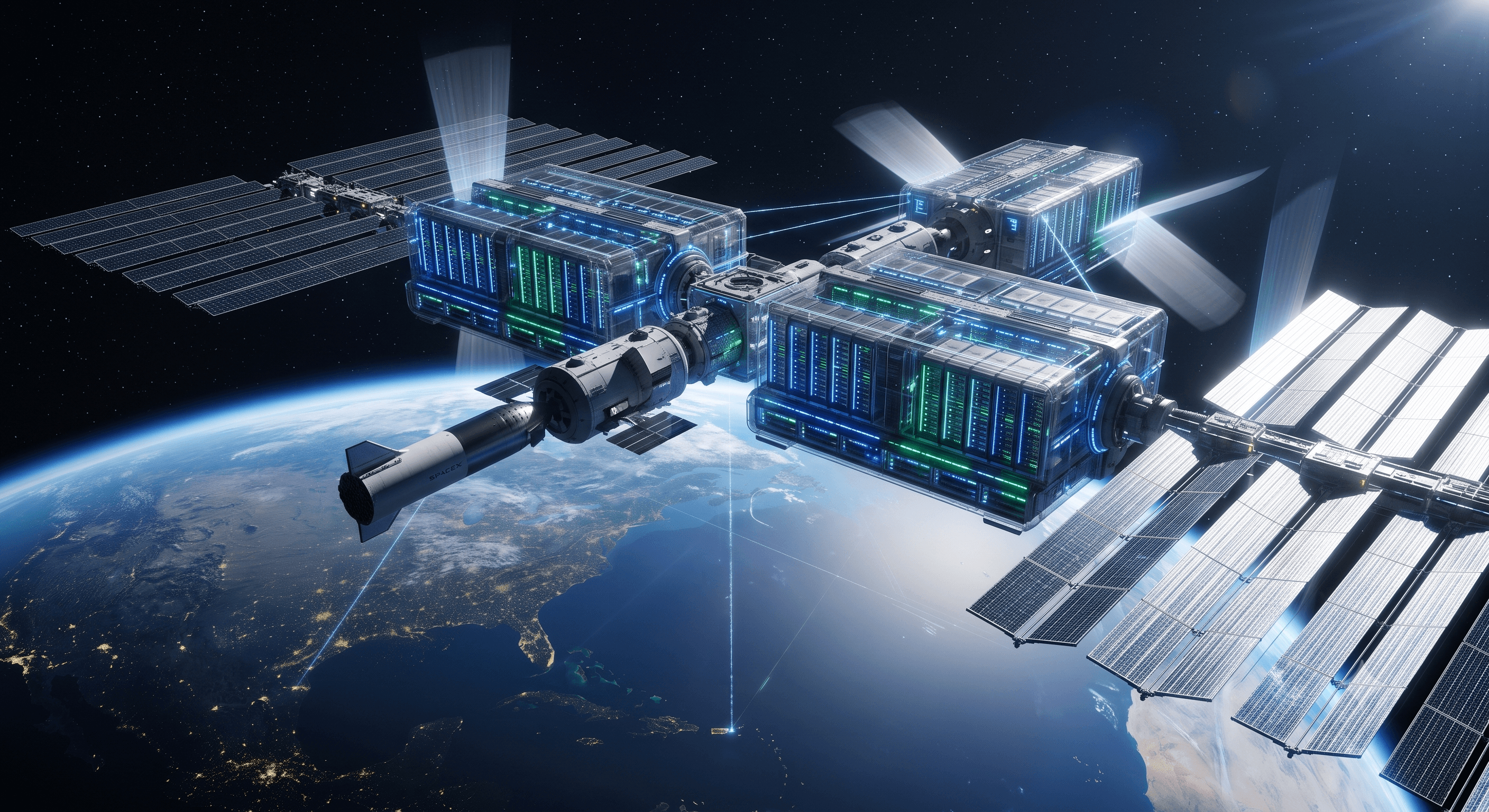
Amid the growing demand for artificial intelligence (AI) and supercomputing, the Earth is facing a serious shortage of land, electricity and water for data centers. As a permanent solution to this global problem, tech entrepreneur Elon Musk is now preparing to move data centers off the Earth's surface and directly into space. An ambitious plan is being considered under the joint vision of SpaceX's 'Starship' rocket and Musk's AI company 'xAI' to float the giant data centers of the future in low-Earth orbit.
Currently, thousands of high-end GPU processors are running day and night to train sophisticated AI models and process large amounts of data, putting a huge strain on the global power grid. A large traditional data center consumes as much electricity as a small city, which is why global data centers are using about 3% to 4% of the world's total energy. In addition, millions of liters of purified water are used daily in cooling systems to prevent supercomputers from overheating. Rising land prices, environmental restrictions, and delays in obtaining grid connections on Earth have created serious obstacles to the expansion of AI infrastructure.
There are many natural advantages to setting up a data center in space against this threat. In low-Earth orbit, outside the Earth's atmosphere and clouds, sunlight is available 24 hours a day, where night never falls. With the help of this inexhaustible and clean solar energy, servers can get continuous power without any electricity grid. Also, since the vacuum of space is extremely cold, there is no need for expensive air conditioners or water to keep the servers cool, but rather heat can be naturally dissipated through special radiators.
SpaceX's Starship rocket will be the main pillar in making this project commercially viable. Starship has the ability to carry 100 to 150 tons of weight into orbit in a single flight at a very low cost, making it economically feasible to deliver modular server racks to space. Along with this, superfast data transmission from space to Earth can also be possible with the help of Starlink's optical space-laser network.
However, the technical challenges to this plan are equally serious. Solar flares and cosmic radiation in space can damage ordinary microchips, making it necessary to develop special radiation-proof silicon charges. In addition, in the absence of human technicians in orbit, the repair and maintenance of servers will have to be completely dependent on autonomous robotics systems. However, given the scarcity of energy on Earth, space-based cloud computing will set a new direction for global technology in the coming years.