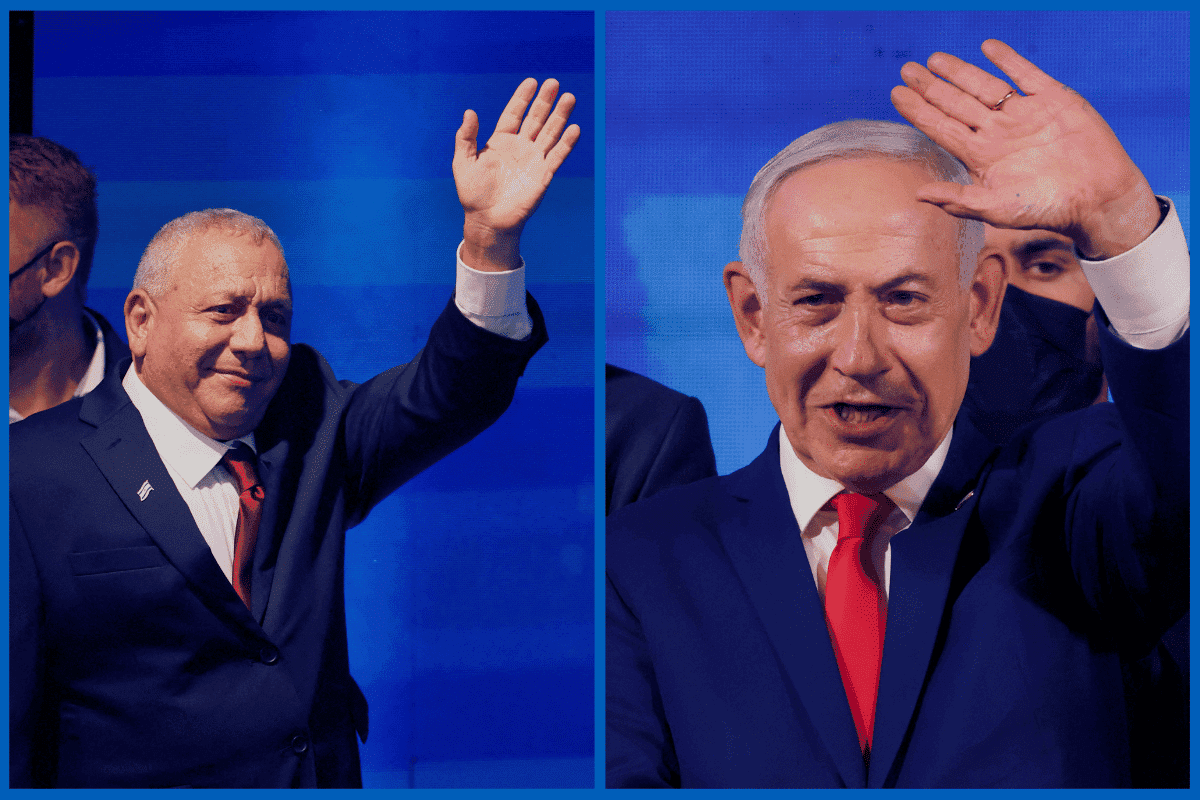
The political deadlock that has been brewing in Israeli politics for some time now appears to be coming to an end. The political deadlock that arose when no party or coalition won a clear majority in the general elections held on October 27 has now been resolved. Former army chief and opposition leader Gadi Eisenkot has crossed the majority mark and his path to becoming prime minister is almost clear.
A majority in the 120-member Knesset requires 61 seats.
Eisenkot received the recommendation of 67 MPs , while Netanyahu received the support of 46 MPs.
The support of the Joint List (11) and Raam (8) increased Eisenkot's strength.
President Herzog has not yet made a final decision ; he will decide after further discussions on who to invite first to form a government.
The support of Arab parties has proven to be the most important factor behind Eisenkot's success. After two days of talks with Israeli President Isaac Herzog, the main Arab parties, the Joint List (11 seats) and the Ra'am Party (8 seats), have officially announced their support for Eisenkot from outside the government. These parties have agreed to recommend Eisenkot to the President as his candidate for Prime Minister.
A majority in Israel's 120-member parliament requires a magic number. With this decisive support from Arab parties, Gadi Eisenkot's numbers now reach 67 seats, which is 6 more than the required majority. This strong coalition means that long-time incumbent Benjamin Netanyahu has to sit out of power. The fact that a former army chief has the support of Arab parties to form a government is considered an unusual and important political equation in Israeli history.
Israeli President Isaac Herzog has said that 67 MKs have recommended Gadi Eisenkot to form a government, while 46 MKs have backed Benjamin Netanyahu . According to official Knesset results , Yashar! 21, Bey'Yahweh 12, Democrats 8 and Yisrael Beitenu 7 = 48 , and adding the Joint List 11 + Ra'am 8 , the total is 67. But there is an important nuance: Herzog has not yet officially invited Eisenkot ; he has said that he will make a decision on Sunday, because the situation is still complicated by coalition vetoes.
On the other hand, there is widespread disappointment in the camp of current Prime Minister Benjamin Netanyahu. He now has the support of only 46 MPs. The biggest blow for Netanyahu is the displeasure of his old and trusted ally, the ultra-Orthodox party 'United Torah Judaism' (UTJ). UTJ has categorically refused to support Netanyahu, putting an end to all possibilities of his government formation. With clear numerical strength, the possibility of Eisenkot getting the first chance to form a government is now a mere formality.