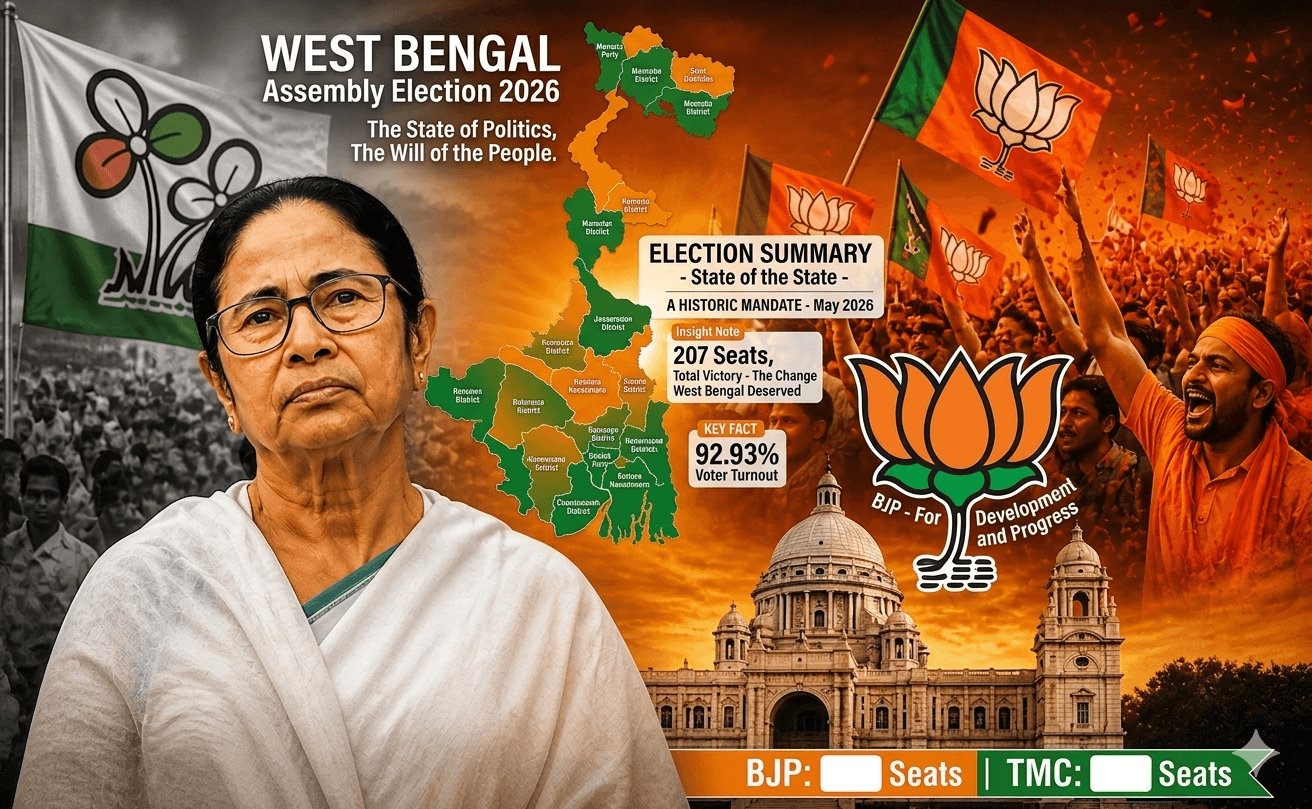
An unprecedented and revolutionary change has taken place in the political history of West Bengal. The Bharatiya Janata Party has demolished the strong fortress of Mamata Banerjee, who was considered invincible in power in Bengal for decades. Why Mamata Banerjee, who won Bengal with a huge majority in the 2021 elections, the same Mamata Didi's party was reduced to only 81 seats in 2026 has become a topic of discussion across the country. The results of 293 seats out of the total 294 seats in Bengal have changed the equations of Indian politics. In this election, BJP has paved the way for forming the government in the state for the first time with a clear majority by winning 206 seats.
The biggest and most shocking reversal of this election has been seen in the Bhawanipur seat. In this seat, Shubhendu Adhikari has once again made Mamata Banerjee taste defeat. Compared to the year 2021, Mamata Banerjee's Trinamool Congress has suffered a huge loss of 134 seats. On the other hand, BJP has succeeded in winning the hearts of Bengalis with its ground-level management and accurate strategy. According to political pundits, SIR i.e. Special Intensive Revision has proven to be the biggest weapon for BJP in this election. With the names of approximately 47,000 to 51,000 voters being deleted from the Bhawanipur seat, there was a big gap in Mamata Banerjee's vote bank. As a result of this technical and strategic change, Shubhendu Adhikari has defeated Mamata Banerjee by 15,114 votes. This victory has proven that BJP's booth-level tactics have been completely successful in breaking Mamata's stronghold.
Political analysts believe that there is not just one reason but a confluence of factors behind Mamata Banerjee's defeat. The special intensive revision in Bhavanipur proved fatal for the Trinamool Congress as it left thousands of its core voters out of the list. Apart from this, the RG Kar Medical College tragedy also sparked huge anger among the people of the state. This incident dealt a major blow to Mamata Banerjee's image as a strong leader of women. The anti-incumbency wave that emerged after 15 years of long rule in the state and the allegations of ever-increasing corruption alienated the middle class from the government. The BJP correctly recognized the public's anger against corruption and cut money culture. Taking advantage of this anger, the BJP fielded a strong face like Shubhendu Adhikari and defeated Mamata Banerjee in her own stronghold.
These results in Bengal have increased the stature and influence of the Bharatiya Janata Party at the national level. For Mamata Banerjee, this defeat is not just a defeat of one seat but is considered to be the beginning of the end of the Trinamool Congress's dominance in West Bengal. Now the state is eyeing the polls on the Falta seat on May 21. The results of this seat will be announced on May 24, which will give the final touch to the BJP's victory chariot. With the end of 15 years of Mamata's rule in Bengal, the political heat is now at its peak in the state. Fulfilling the trust that the public has placed in the BJP against corruption and on the issue of security will be a big challenge for the new government. Now it remains to be seen how the Bharatiya Janata Party makes a new start to rule in Bengal and what kind of development it brings to Didi's stronghold. This election in West Bengal will always be remembered as a big change in the history of Indian democracy.
With Mamata Banerjee refusing to resign and accept the election results, the following developments are likely to take place in the state at the political and legal levels:
Process of formation of new government: As per the rules and procedure, Mamata Banerjee has to resign from the post of Chief Minister and continue as a caretaker (temporary) till the swearing-in of the new government.
However, he may face difficulty in sticking to his stance of not resigning as Chief Minister.
The term of the current assembly ends on May 6.
BJP will stake claim to form the government: As the majority party, BJP will now stake claim to form the government, after which the Governor will invite their leader to take oath.
The swearing-in ceremony of the new government is likely to be held on May 9 (Rabindranath Tagore's birth anniversary).
TMC's legal battle: Mamata Banerjee and her party (TMC) are now hinting at fighting a multi-pronged political and legal battle.
TMC may explore legal options like filing an election petition in the Calcutta High Court
In addition, a mass petition challenging the Special Intensive Revision (SIR) process and the issue of deletion of names from the voter list can also be filed in the Supreme Court.
Political mobilization and support of INDIA bloc: Mamata Banerjee has made it clear that her target now is to strengthen the INDIA alliance and she will do extensive political mobilization at the grassroots level.
Many leaders of the opposition alliance have extended their support to him and leaders including Akhilesh Yadav are expected to visit him.
Formation of inquiry committee: A 10-member fact-finding committee (investigation committee) will be formed by the TMC to visit and investigate the areas affected by the post-election violence.
According to another argument, TMC MP Kalyan Banerjee has said that since the Model Code of Conduct (MCC) has been in force in the state for the last 3 months, the administration was being run by the Chief Secretary and Mamata Banerjee was not working as the Chief Minister, so there is no question of her resignation.