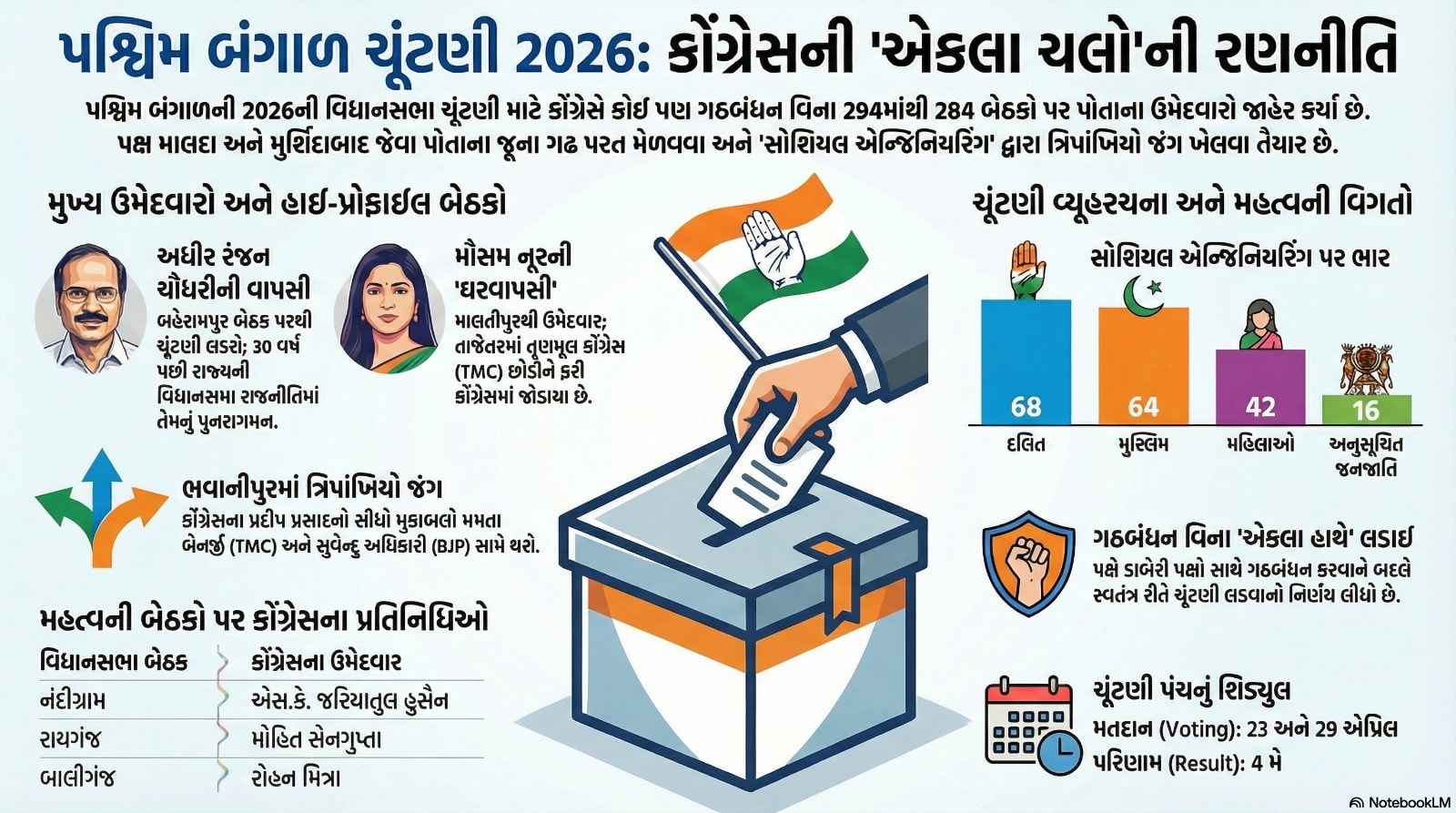
Till now, the main contest in West Bengal politics was between Mamata Banerjee's Trinamool Congress (TMC) and BJP. But, for the upcoming assembly elections, Congress has made this fight 'triangular' by declaring its candidates on 284 seats. This move by Congress, which has entered the fray without an alliance, has completely changed the political equations of Bengal.
Bet on veteran leaders: Adhir Ranjan returns to the fray
Congress has fielded its most experienced leaders this time. Former state president Adhir Ranjan Chowdhury will contest the assembly elections after almost 30 years. He has been given a ticket from his stronghold, Berhampur. Apart from this, Congress has made the fight interesting by fielding Pradeep Prasad against Mamata Banerjee and Suvendu Adhikari on high-profile seats like Bhawanipur. After the 'gharvapasi' of Mausam Benazir Noor, he has been given a ticket from Maltipur.
A look at social engineering and Muslim votes
Congress has adopted a special strategy in selecting candidates this time:
Class-wise representation: 68 Dalits, 64 Muslims, 16 Scheduled Tribes and 42 women candidates.
Target areas: Congress wants to strengthen its old hold in Muslim-majority districts like Malda, Murshidabad and Uttar Dinajpur.
Who loses, who gains?
Political analysts believe that if Congress fights strongly, it will have a direct impact on Trinamool Congress . Muslim voters have traditionally been with Mamata Banerjee, but if Congress makes a dent in these votes, then BJP can get a direct benefit from it. However, Congress can also cut BJP's votes by fielding young and professional candidates in urban areas.
An attempt to erase the zero figure of 2021
In the 2021 elections, Congress did not get a single seat. At that time, TMC got 213 seats and BJP got 77 seats. This time, Congress's main objective is to regain its old stronghold and emerge as a major party in Bengal again. If Congress wins even 2-3 seats in Malda or Murshidabad, it will be considered a big success in the politics of the state.